


> Community > Stories > Science meets science fiction: How entrepreneurs and authors envision the future
20.03
2026

Science meets science fiction: How entrepreneurs and authors envision the future

Self-driving cars, autonomous robots, virtual reality. Just a few years ago, these inventions belonged to the realm of sci-fi. Now, as technology advances at an unprecedented pace, we’re watching the fantastical become reality. This leads us to wonder: what is the relationship between science and sci-fi? Are entrepreneurs inspired by sci-fi when they’re thinking up new inventions? Can the work of scientists inform the work of sci-fi writers and vice versa? How important is real science in sci-fi? In this interview, we explore these questions with sci-fi expert Marc Atallah, who carries out research on the genre, and scientist and entrepreneur Sébastien Nusslé, who co-founded epigenetics company Genknowme.

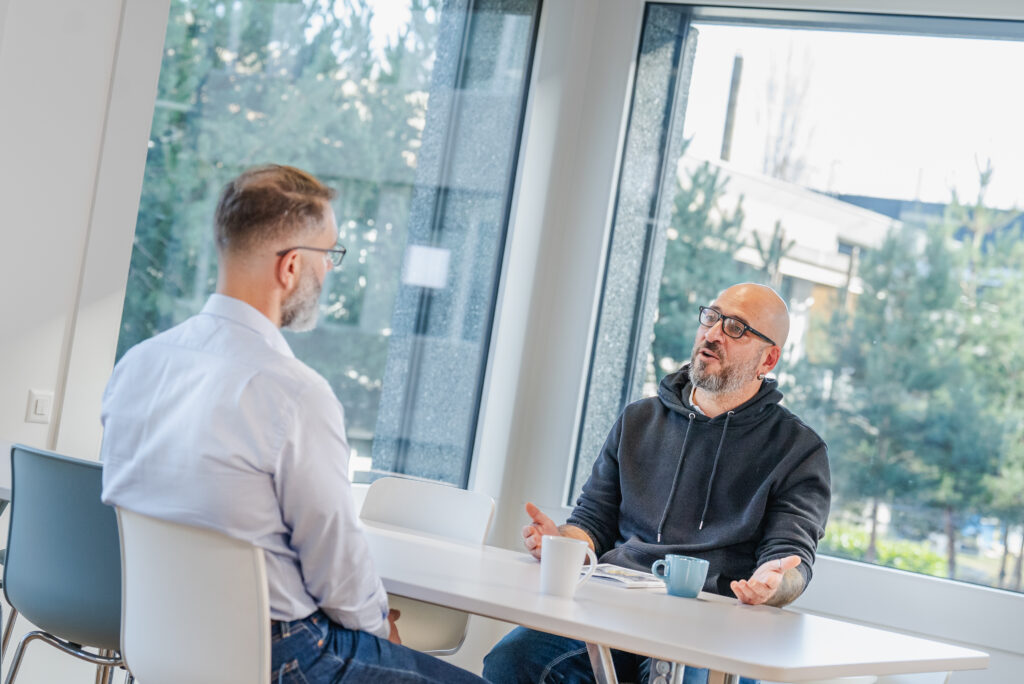
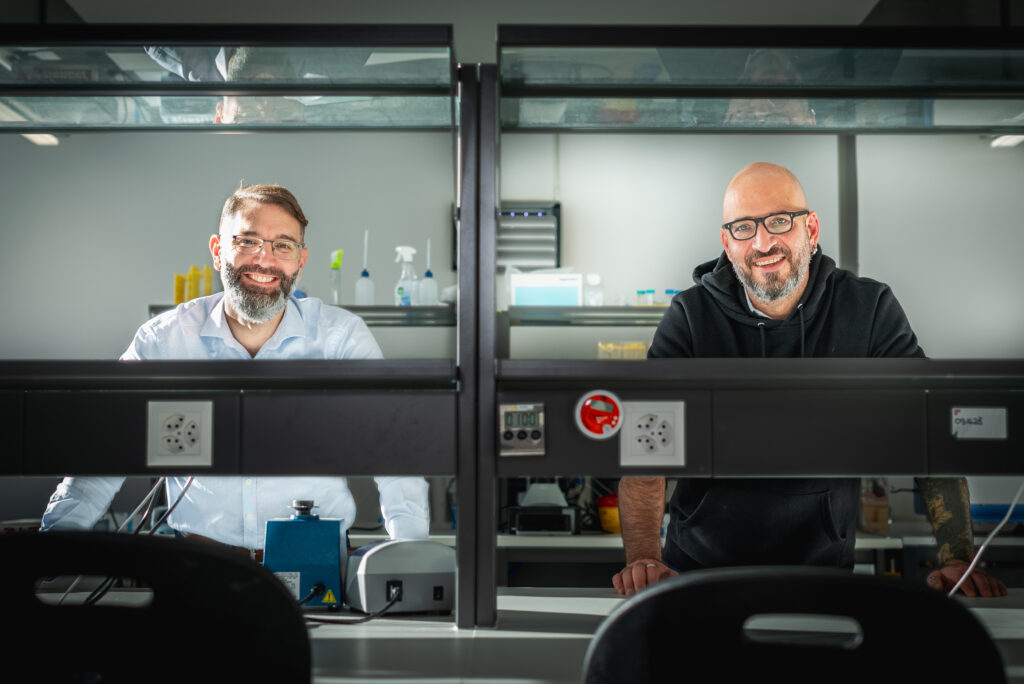
Scientist and entrepreneur Sébastien Nusslé (left) meets Senior Lecturer in French literature Marc Atallah (right) at StartLab. Both are interested in science fiction and here they share their perspectives on the role of this genre in science and wider society.

Biopôle: Marc, as a sci-fi expert, could you start by giving us a brief definition of ‘science fiction’?

Marc: There are many ways of defining it. But a good definition of science fiction today is that we take our scientific or technological knowledge as a starting point, and we extrapolate this into a future scenario. This gives us a storyline. If we take a smartphone as a starting point, we might imagine a story where a SIM card is put in our brain, for instance. And we then imagine a plot and a fictional world around this. Whether it’s catastrophes, dystopias or time travel, everything in sci-fi is an extrapolation of what we know today. Of course, most of it won’t actually happen. But sci-fi allows us to dream about how the future might look.

Biopôle: As a scientist and entrepreneur, what is your relationship to sci-fi, Sébastien?

Sébastien: I got into sci-fi when I was a kid and I think it fuelled my interest in science. At the time, my fascination with Captain Nemo and his submarine drove my interest in marine biology. Now, as a scientist, I see sci-fi as a tool to escape from everything we’re frustrated with: ‘I wish we could have this and that.’ It is a way of imagining science and technology without constraints. In some ways, it could also be seen as a guidebook. Often sci-fi presents ‘what if’ scenarios. It lets us play out these scenarios and think about what could happen – and what we could do about it. But I also just love getting immersed in sci-fi. Even though I’m a scientist, I’m happy to suspend disbelief. I will happily accept that we can travel faster than light, teleport and do things that are currently impossible.
Biopôle: For his book From the Earth to the Moon, Jules Verne calculated the velocity needed for a rocket to reach the moon and his calculation turned out to be surprisingly accurate for the time. How much research does a sci-fi writer need to do? How much does accuracy matter in your view?

Marc: Writing a novel always involves a lot of research. Of course, for science fiction, this research must in part be linked with science. But if you take dystopian stories, often the only link to science is at the very start, where we’re told that something happened and the world was destroyed. The rest of the plot is about what happens to the main characters. It’s not about science or technology, yet it’s still sci-fi. Of course, there are other examples that are full of science and technology, but there aren’t rules about how much science needs to feature in a sci-fi story. What is interesting in fiction are the emotions it makes us feel, the impression that we are living another life. And accuracy has nothing to do with this.

The example you mention is a very good one, as Jules Verne was suspicious about science. He wasn’t interested in telling stories about science, but about human beings in a world full of science. In his view, a world dominated by invention and machines would be sad and dystopian. Science fiction isn’t really about science, but a reflection of how human beings live today.

Sébastien: To add to this, I would say that sci-fi authors project themselves into a futuristic world, but authors in general need to project themselves. Take Ken Follett who writes books about historical events. He has to imagine what life was like in, say, the 12th century. There’s always a need for authors to imagine, to visualise a world that is different to their own. In sci-fi, future scenarios are a tool to encourage us to reflect on our behaviour today and on our relationship with innovation. For example, we see our mobile phones as tools but we don’t really think about what’s behind them and the consequences of using them. In 1984, people don’t read any more – they just watch their screens. I’m witnessing this with my kids and with myself. We read less because there’s much more on screen to watch. In fact, nowadays I tend to watch sci-fi more than I read it, just because it’s faster and easier. And I wouldn’t really question it if it weren’t for books like 1984, which make me pause and reflect on whether we might have reached a similar situation. By portraying these scenarios, science fiction encourages us to reflect on our own condition, on how we use technology today.

 Science fiction, through its stories, can help us become specialists of the present

Biopôle: You mention that authors visualise a world that is different to their own. What about for you as an entrepreneur? Your aim is to develop a solution that doesn’t exist in the real world yet, so there’s some visionary thinking there. How much do you think this relates to sci-fi?

Sébastien: It’s true that a lot of what we’re aiming for doesn’t exist yet and so you have to imagine everything that might be possible. At Genknowme, we’ve developed a way to read the genetic markers present in your DNA to see if your genes are physically modified by your way of life. But that is the first step. Many questions follow: how can we do this? How will it work? How can we change these physical markers? How can we predict cancer or dementia ten years before it happens? None of this is currently possible, but we’re trying to make it happen – to bring into the world something that doesn’t yet exist. We can compare this to sci-fi, in that we’re imagining a scenario that might happen or might not even be feasible. As an entrepreneur, you need this forward thinking to imagine what could happen. For me, sci-fi can nourish creativity and ambition. That said, to be an entrepreneur you also need to build on something that exists, on existing science – so there’s a balance to strike.

Marc: I don’t think sci-fi is a good guide for entrepreneurs. It shouldn’t be viewed as a tool to see into the future. If you’re an entrepreneur, you need to find an interesting market for the future. Because 99% of the innovation you see in sci-fi has never been invented and never will – it’s fake. It’s there to tell a story. But if you understand that sci-fi is a good way to look differently at our present, it might help entrepreneurs anticipate not the trends of tomorrow’s market, but those of today’s market. Sci-fi imagines tomorrow based on what we are today. And science fiction, through its stories, can help us become specialists of the present.

Biopôle: Sci-fi often portrays technology gone wrong. Sébastien, how has sci-fi encouraged you to think about the ethics of your work?

Sébastien: That’s a very good point. Sci-fi brings this idea of risk and the space to explore the good and bad that can result from science. It allows us to delve into scenarios without them actually happening.

I really like the film Gattaca, which is about a man who challenges a genetically engineered society by pursuing his dream of space travel, even though he was ostensibly born with genetic defects. There’s this dual idea – on the one hand, yeah it works, it’s cool to be able to change our genetics and create ‘perfect’ human beings. And on the other hand, we don’t need this. Unlike many other sci-fi films, the morals aren’t black and white. And it encourages us to ask questions. In my field – genetics – a question that very often comes up is, ‘If health insurance companies have access to my epigenetic data, could it backfire?’ As we make scientific progress, there are also risks to consider. Could the intimate biological data held by companies be used against us? Could there be ‘uninsurable’ human beings, just like the ‘invalid’ ones in Gattaca? We can imagine many sci-fi scenarios that might explore these questions. We have to remember, though, that in the real world, there are laws that say we can’t discriminate. But science fiction can be a way of exploring ethics, of asking ‘Would we be OK with this?’

Marc: Exactly. As Sébastien was mentioning earlier, sci-fi incites us to pause and ask ourselves questions. And I think one of its main functions is to say that, behind interesting science and technology, there is also ideology. Some of these ideologies are good and others may be less so. Having a symbolic space that leads people to question ideology is very important.

Biopôle: Marc, you’re an advocate of teaching critical thinking in schools. How do you envision this taking place?

Marc: I teach literature at university. It could be interesting to include sci-fi novels in the secondary-school curriculum, alongside other genres. Right now, science fiction isn’t taught at secondary level in Switzerland, despite the fact that teenagers gravitate towards the genre, playing sci-fi video games and reading sci-fi comic books.

And maybe we could also create links between different subjects. For instance, if you’re studying physics or biology, you could use sci-fi to explore the question: what is a black hole? Of course, we know what a black hole is, but it could be interesting if a physics professors said: ‘This is what science says about black holes, but there is another way of looking at it, because the black hole is also an important image in sci-fi. It could say something else.’ And adding poetry to science could, in turn, lead to more creativity.

Biopôle: What about you, Sébastien – do you think schools should be focusing more on critical thinking skills?

Sébastien: As a former teacher, I can speak to my own experience. One of the roles of schools is certainly to teach critical thinking and to make those links between science and arts and literature. It’s expected from teachers, but they often don’t have the means. You can’t do that with 30 children in one classroom. There are more and more children to work with, and the curriculum is becoming larger and larger. I would advocate for focusing less on knowledge and encouraging more of these exchanges, but that requires fewer students in a class. When working with big groups, it’s easier to learn a formula or summarise a book. Critical thinking is a hard skill to teach.

Of course we need more links between disciplines, but teachers need time to get together and work on this. Given the way schools are organised, we’re not going in this direction. But who cares how many books you read or how many exercises you do?

What’s important in the end is how you think. In short, yes, schools should be teaching these skills, but it’s no easy task.

Biopôle: Marc, do you have any last reflections to share?

Marc: As soon as we understand that the main purpose of sci-fi is dealing with humans, not with scientific innovation, we can generate some interesting reflections. It encourages us to ask: what kind of world do we want to live in tomorrow? Because when I think about my children, I’m interested in how they will live in 20 years. When our different disciplines, like fiction, economics and politics, focus on human beings and there’s interdisciplinary discussion – like we’re doing right now – so many interesting things come out.

Talking to others in different fields isn’t just a good way to obtain funds for your company or research. It’s about finding different ways to live together – which could be better than the one we know today. Science and technology will be more and more present in our lives. There’s no way to stop this evolution, but we can learn how to think about it. Science fiction will not think for us, but it gives us some tools to think more productively.

Marc Atallah
Lecturer and researcher at the University of Lausanne (UNIL

Marc Atallah is a sci-fi expert who has written books such as La parade monstrueuse: La naissance des monstres modernes, L’homme-machine et ses avatars and Pouvoirs des jeux vidéo: Des pratiques aux discours. He was Director of the Maison d’Ailleurs, a sci-fi museum in Yverdon-les-Bains, between 2011and 2020. Marc is also a lecturer and researcher in the Department of French at the University of Lausanne (UNIL).

Sébastien Nusslé
CEO and co-founder of Genknowme

Sébastien Nusslé is an experienced researcher in biostatistics who specialises in genetic and environment interactions. He co-founded Genknowme, which analyses how lifestyle affects our gene activity through epigenetics to give personalised health insights. He hopes to help democratise this technology so that everyone can lead a healthier life.

COMMUNITY STORIES, THAT MAKE US PROUD

Overcoming obstacles together: The future of user-centric sight tech
Building impactful careers at Bewe
AI in clinical development